Table of Contents
Key Takeaways
- Balancing on two wheels actively calibrates the vestibular system and builds proprioception – the body’s subconscious sense of where it is in space.
- Training wheels create a false sense of security – they teach pedalling mechanics but completely bypass the neurological challenge of balancing.
- The electric throttle reduces cognitive overload – removing pedalling lets kids isolate and master one skill at a time (leaning, steering, braking).
- Minor falls and recoveries on the trail build emotional resilience that carries over to abstract challenges like schoolwork and social situations.
- Confident riding puts kids into a mindful ‘flow’ state – a well-designed balance bike is a vehicle for neurological development, not just a toy.
In an era increasingly defined by sedentary digital engagement, the simple act of a child learning to balance on two wheels has taken on profound developmental significance. Beyond the obvious cardiovascular benefits and the pure joy of outdoor play, mastering the art of balance—particularly on modern, lightweight electric balance bikes—is a complex neurological exercise. It shapes a child's developing brain in ways we are only beginning to fully understand, acting as a crucial counterbalance to the hyper-stimulating, two-dimensional world of screens.
1. The Neuroscience of 'Staying Upright'
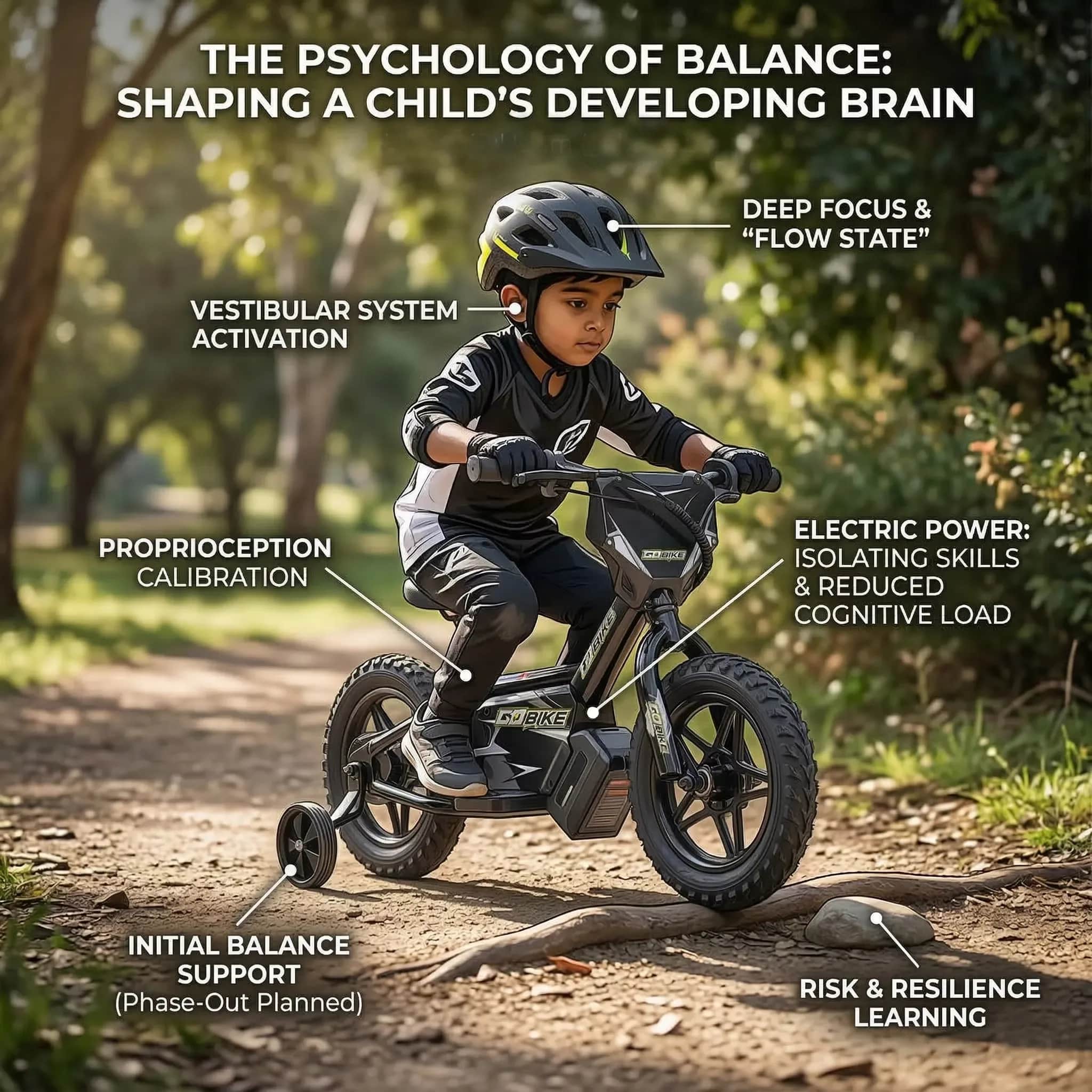
When a child mounts a balance bike and pushes off the ground, they aren't just playing; they are actively engaging and calibrating their vestibular system. Located deep within the inner ear, this system is the brain’s primary control centre for spatial orientation, motion detection, and equilibrium.
- Building Proprioception:According to pediatric occupational therapists, dynamic activities that consistently challenge the vestibular system are critical for developing proprioception. This is the body’s subconscious ability to sense its location, movements, and actions in physical space. A well-developed sense of proprioception is linked to better posture, improved focus in the classroom, and advanced athletic ability later in life.
- The Problem with Stabilisers:For decades, traditional bikes with stabilisers (training wheels) were the go-to learning tool. However, neurologically speaking, they create a false sense of security. They teach a child the mechanical motion of pedalling, but they completely bypass the neurological challenge of balancing. When the stabilisers are eventually removed, the child’s brain is forced to learn a completely new, often terrifying, set of physical rules. A balance bike, conversely, introduces the core concept of equilibrium from day one, allowing the child's nervous system to adapt organically and safely.
2. Cognitive Load and the Electric Advantage
One of the most significant and sometimes misunderstood advancements in modern outdoor play is the transition to electric balance bikes. While some parents might initially view the addition of a motor as simply a way to 'go faster,' the psychological and educational benefits are far more nuanced.
- Managing Cognitive Overload:When a young child is learning to ride a traditional pedal bike, the physical exertion of pedalling often overwhelms their cognitive load. They are simultaneously trying to coordinate their legs in a circular motion, steer, watch for obstacles, and keep their center of gravity from shifting too far to either side. It is a massive multitasking demand for a developing brain.
- Isolating Skills for Mastery:By removing the immediate need to pedal and replacing it with a gentle, parent-controlled electric throttle, the child can isolate and master one crucial skill at a time. They learn the complex physics of leaning into a turn, the hand-eye coordination required for braking, and the subtle shifts in body weight needed to stay upright. This step-by-step mastery builds a foundation of deep, embodied confidence.
3. Risk, Reward, and Emotional Resilience
The environment in which this learning takes place is just as crucial as the tool itself. Navigating a bumpy dirt trail, a grassy park incline, or a gravel path requires hyper-focus and situational awareness.
- Overcoming the Fear of Failure:On the trail, minor falls and slips are inevitable. Every time a child loses their balance, puts a foot down to catch themselves, and gets back up, they are building emotional resilience. They learn firsthand that falling is a natural part of the learning process and that their bodies are remarkably capable of self-correction.
- Translating Physical to Emotional Strength:This physical resilience directly translates to emotional resilience. A child who learns to conquer a daunting hill or a tricky corner on their bike is cultivating the mental fortitude to tackle abstract challenges—like a difficult math problem or social anxiety—off the bike as well.
4. Entering the Mindful State of 'Flow'
Psychologist Mihaly Csikszentmihalyi popularized the concept of "flow"—a state of deep absorption in an activity where time seems to stand still, and the ego falls away. When a child is confidently navigating a trail on a balance bike, making micro-adjustments to their speed and direction, they frequently enter this flow state. It is a form of moving mindfulness. A child cannot be distracted by anxieties or past events when they are negotiating a tree root or a muddy puddle; they must be entirely present in the "now."
As we advocate for a societal shift from "Screen Time to Green Time," it is essential to recognize that the tools we provide our children matter immensely. A premium, well-designed balance bike is not just a toy; it is a vital vehicle for neurological development, a builder of unshakeable confidence, and a catalyst for a lifelong, mindful connection with the natural world.
Ready to start the adventure?
Shop Australia's best-rated electric bikes for kids. Built for safety, engineered for fun.
Shop All Bikes →
Gobike
GoBike Australia
Australia's leading provider of premium electric balance bikes for kids — getting children outside and building real confidence.
Leave a Comment
Be the First to Comment
Your email address will not be published. Comments may be moderated before appearing.